Confidence in Chaos: How to Stay Invested Through Market Volatility

Would you rather be out of the stock market when it goes down, or risk being out when it rebounds? It is a tongue twister, but it gets to the heart of one of the most important questions in investing.
There is no reliable way to consistently exit the market before downturns and reenter before recoveries. Over time, investors are faced with a trade-off: accept short-term market volatility in pursuit of long-term growth, or risk missing the very moments that drive returns.
As risk-averse humans, most of us choose to live with the ups and downs of the market to fund retirement and achieve meaningful life goals. That decision, however, does not make the emotional side of investing any easier.
So how do you live with market volatility? How do you build confidence in chaos?

Understanding Your Risk Tolerance
Risk tolerance is one of the most important variables in constructing a portfolio. Just because you could take on more risk does not mean you should.
Finding the Right Balance
A portfolio invested entirely in stocks may offer higher long-term return potential, but it also comes with greater short-term swings. For many investors, a more balanced mix of stocks and bonds provides a smoother experience.
This balance becomes especially important during extended market downturns. Bonds can serve as a stabilizing force, helping to support lifestyle needs without forcing you to sell stocks at depressed prices. They can also provide liquidity to rebalance into equities when valuations become more attractive.
Determining the right mix is not about chasing returns. It is about aligning your portfolio with your goals, your timeline, and your ability to stay invested through uncertainty.
The Role of Diversification in Market Volatility
A well-diversified portfolio is another essential component of navigating market volatility.
Spreading Risk Across Markets
Rather than concentrating investments in a single area, diversification spreads exposure across asset classes, sectors, and geographic regions. This approach helps reduce the impact of any one area experiencing significant decline.
It is often said that “diversification means always having something to apologize for.” At any given time, some portion of your portfolio may underperform. However, that same structure helps reduce overall volatility and creates a more consistent investment experience over time.
By owning a broad mix of investments, you are not relying on a single outcome to achieve success. Instead, you are building resilience into your portfolio.
Discipline: The Foundation of Long-Term Confidence
Even the most thoughtfully constructed portfolio requires discipline to be effective.
Staying Invested When It Matters Most
Market volatility is often accompanied by heightened emotions. Headlines, uncertainty, and short-term losses can make it tempting to react. This is where having a defined investment process becomes critical.
A disciplined approach helps remove emotion from decision-making and keeps your strategy aligned with your long-term objectives.
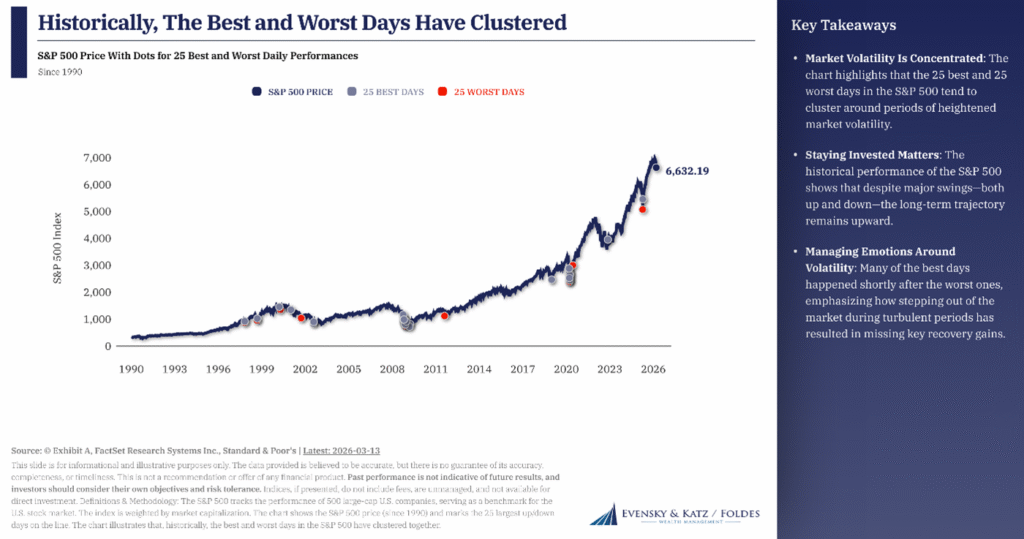
History reinforces the importance of staying invested. Over the past century, the stock market has endured wars, recessions, and crises—and has recovered every time. While past performance is not a guarantee of future results, it provides important context.
It is also worth noting that the best and worst days in the market tend to occur close together. Missing just a handful of strong recovery days can significantly impact long-term returns. Investors who remain disciplined during downturns are often the ones who benefit most from eventual recoveries.
Putting Confidence Into Practice
Building confidence in market volatility does not come from predicting what happens next. It comes from preparation.
A strong financial plan, aligned with your personal goals and risk tolerance, provides a framework for decision-making during uncertain times. It allows you to act with intention rather than react out of fear.
Working with an advisor can help bring clarity to that process—ensuring your portfolio is structured appropriately and that you have a plan in place before volatility arises.
Connect with us to discuss your personal risk tolerance and build a financial plan designed to help you stay confident through every market cycle.
Categories
Recent Insights
-

Retirees have questions for financial advisers. Here’s what they want to know.
Roughly a third want advice for what to do with the money in their former workplace plan, while nearly 3 in 10 want a withdrawal strategy that turns savings into retirement income. Others seek help with taxes, long-term care planning, debt reduction, or estate planning.
-

Markets & Mindset – July 2026
Lane Jones, Principal and Chief Investment Officer, and Marcos Segrera, Principal and Wealth Manager, help you make sense of what’s happening in today’s markets — and how to stay focused on what matters most.
-

Do You Have More Spatulas Than Financial Accounts? A Case for Consolidation
We added another wooden spatula to our kitchen recently. And when I say another, I mean to an already impressive collection. At this point, we could host a dinner party for 15 people and assign each dish its own spatula. Is that necessary? Probably not. But I am not the chef or the party planner—and…
-

The Cost of a Good Idea — And What Golf Taught Me About Leaving It Alone
I started playing golf about a month ago. And let me be honest with you — it’s the most humbling thing I’ve done in recent memory. I grew up playing baseball, so I figured I’d have at least a fighting chance. The coordination, the swing mechanics — how different could it be? Turns out, very.…
-

Do You Own Your Time?
When a full calendar feels like success I am infamous for having a calendar booked for months in advance. When this first started happening, it felt good. Early in my career, I didn’t have enough work to fill my time, so the goal was simple: get as many meetings booked and clients closed as possible.…