Why do experts call my 401k a “qualified plan”?

The quick answer is: A qualified plan is an employer-sponsored retirement plan that qualifies for special tax treatment under Section 401(a) of the Internal Revenue Code.
Now for some not too detailed details…
There are many different types of qualified plans, but they all fall into two categories. (1) Defined benefit plans (like a traditional pension plan) are generally funded solely by employer contributions and provide you with a specified level of retirement benefits. That specific level of benefit is why it is called a defined benefit plan. (2) Defined contribution plans (like a profit-sharing or 401(k) plan) are funded by employer and/or employee contributions. For these types of plans, only the contributions are defined as you don’t know exactly what the benefit will be in the future. The benefits you receive from the plan depend on investment performance and your and your employer’s contribution.
The annual contribution limits and other rules vary among specific types of defined benefit and defined contribution plans. However, most qualified plans share certain key features:
- Pretax contributions: Employer contributions to a qualified plan are generally able to be made on a pretax basis. That is, you don’t pay income tax on amounts contributed by your employer until you withdraw money from the plan. Your contributions to a 401(k) plan may also be made on a pretax basis.
- Roth contributions: Your employer may also allow you to make after-tax Roth contributions to the 401(k) plan. While there’s no up-front tax benefit, qualified distributions are totally free from federal income taxes.
- Tax-deferred growth: Investment earnings (dividends, interest, capital gains) on all contributions are tax-deferred. Again, you don’t pay income tax on those earnings until you withdraw money from the plan.
- Vesting: If the plan provides for employer contributions, those amounts (and associated investment earnings) must vest before you’re entitled to them. For example, a five-year graded vesting schedule could give 20 percent ownership after the first year, then 20 percent more each year until employees gain full ownership after five years. If the employee leaves before five years have passed, he or she only gets to keep the percentage that has been vested. One reason employers do this is to help retention.
- Creditor protection: A creditor is a person or company that you owe money to. In most cases, your creditors cannot reach your qualified retirement plan funds to satisfy your debts.
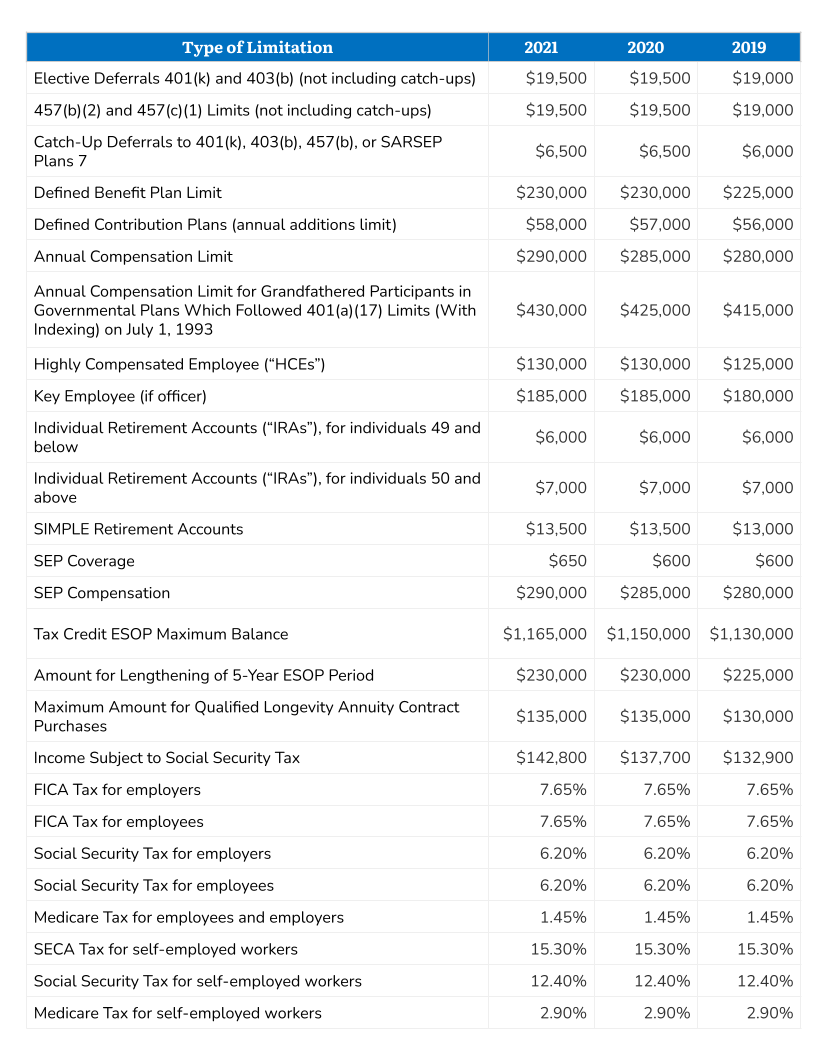
Lastly, I mentioned differences in annual contributions. Below is a breakdown of the different limits. Important to note that since traditional IRAs and Roth IRAs are not sponsored by an employer, they are technically not qualified plans. I’ve included past years for comparison purposes. Some of the “types of limits” may not be intuitive based on the name. That’s a good opportunity to reach out to us and find out what each means!
Happy Investing!
Marcos
Categories
Recent Insights
-

The Rise of Financial Independence for Women: Rewriting the Rules of Wealth and Retirement
For generations, financial planning followed a fairly predictable script: get an education, build a career, get married, raise a family, then retire. Today, that script is being rewritten. Women are marrying later than previous generations, and a growing number are choosing not to marry at all. As a CFP® who spends most of my time…
-
Talk Your Chart | Tariffs, the Fed’s Next Move, and Lessons From the Dot-Com Bubble | Ep. 80
In Episode 79 of Talk Your Chart, Marcos and Brett break down the market’s rare pullback, as they talk through the latest jobs report, interest rates, and what could pressure markets next. They also dig into the durability of the AI boom, South Korea’s rise as a global equity market, and how massive IPOs like…
-

Plan Intentionally: Designing Retirement Around the Moments That Matter Most
Retirement planning has always been about more than numbers on a spreadsheet. At its core, it is about securing the freedom to live with purpose, stay connected to the people who matter most, and show up for life’s real moments when they matter most. Too often, conversations about retirement become consumed by growth rates, projections,…
-

What Lubbock Quietly Teaches About Wealth
After years of working with families in Lubbock, we’ve come to appreciate something that rarely gets said out loud: wealth is not just what you accumulate. It is what your environment allows you to keep, experience, and enjoy. And in that sense, Lubbock has a way of teaching lessons that extend far beyond financial planning.…
-

The Marketing Philosophy Gap: The Leadership Blind Spot Behind Modern Marketing
Every few months, I come across another article asking why RIAs are struggling to hire great marketers. Meanwhile, my LinkedIn feed is flooded with experienced marketers looking for work. Somehow, in the current market, both things seem to be true. But as the kids would say: The math ain’t “mathing.” I don’t think firms have a marketing hiring problem. I think they have…